
Rogue Valley Local Guide • Updated August 2026
How Wildfire Smoke Damages Carpet Fibers — And What Actually Fixes It in Medford
A Medford-specific breakdown of what wildfire smoke does inside your home, why the Rogue Valley gets hit harder than most Oregon cities, and what it actually takes to get it out of carpet fibers permanently.
By Medford Carpet Cleaner • 34 S Fir St, Medford OR 97501 • (458) 346-2026
Quick Answer
Wildfire smoke damages carpet fibers in Medford, Oregon through a process called adsorption, where PM2.5 particles (2.5 micrometers or smaller) bond chemically to carpet fiber surfaces. The Rogue Valley’s enclosed bowl geography and Jackson County’s 100+ annual hazardous air quality days concentrate smoke indoors at higher levels than most Oregon cities. Standard vacuuming cannot break the adsorption bond. Only hot water extraction at 230°F with alkaline pre-treatment removes bonded PM2.5 from carpet fibers. Professional treatment within 30 days of an air quality event produces the best results.
Why Medford Has a Wildfire Smoke Problem That Portland Doesn’t
Look at a topographic map of Southern Oregon and you can see the problem immediately. Medford sits at approximately 1,380 feet elevation in a valley surrounded by mountains. The Cascades to the east, the Siskiyou Range to the south, and the Coast Range to the west form a natural enclosure. When temperature inversions develop — a warm air layer trapping cooler air at valley level — that enclosure becomes a lid.
Drive from Medford up Highway 62 toward Crater Lake on a smoky August day and you will see exactly where the bowl ends. The smoke sits below a clear line. Above that line, the air is clean. Below it — in Medford, in Eagle Point, in Central Point, in Talent and Phoenix — the smoke concentrates.
The Oregon Department of Environmental Quality tracks AQI data across the state. Jackson County’s numbers during fire season routinely exceed those of the Willamette Valley even when the same fires are burning. The valley’s orientation, the surrounding terrain, and the frequency of temperature inversions all amplify the problem locally. In heavy fire years, Jackson County has posted AQI readings above 300 — a level the EPA classifies as “Hazardous.” The 2021 and 2023 fire seasons both produced weeks of sustained unhealthy and very unhealthy readings across the Medford metro area.
What PM2.5 Actually Is and Why It Bonds to Carpet
PM2.5 refers to particulate matter with a diameter of 2.5 micrometers or less. For comparison, a human hair is roughly 70 micrometers wide. PM2.5 particles are about 1/30th that size. They are invisible to the naked eye and light enough to remain airborne for hours or days before settling.
When wildfire smoke particles eventually settle indoors, they land on every horizontal surface in the home. Carpet is the largest horizontal surface by area in most residences. The particles do not just rest on the carpet — they bond to the fiber surface through a chemical process called adsorption. Unlike absorption, where something is taken inside a material, adsorption creates a surface-level bond between the particle and the fiber wall. The bond is chemical and requires energy to break.
This is why the smell persists after the air outside has cleared. The particles bonded to carpet fibers continue volatilizing odor compounds into your indoor air. Running fans moves the ambient air but does nothing to the bonded particles. Vacuuming applies suction to the surface but does not have the force or chemistry to break an adsorption bond. The smell stays.
The Indoor Pathway: How Smoke Gets Into Sealed Medford Homes
The most common question we hear from Medford homeowners after fire season is some version of “My windows were shut the whole time, how did it get in?” The answer is that PM2.5 particles at 2.5 micrometers are smaller than the gaps in most residential construction.
Standard weatherstripping compresses when a door closes but rarely seals completely. Window weatherstripping ages, compresses unevenly, and leaves micro-gaps. HVAC systems draw outdoor air through return intakes and distribute it through the home. Older Medford homes — the 1950s and 1960s construction common in the central city — were built without today’s air-sealing standards. Every time a door opens, outdoor air exchanges with indoor air.
During a sustained AQI event, the outdoor concentration of PM2.5 is high enough that even limited air exchange brings measurable smoke particulate inside. A study published in Environmental Science and Technology found that indoor PM2.5 concentrations during wildfire smoke events typically reach 65 to 85 percent of outdoor levels even in relatively well-sealed homes. In older construction, that figure climbs higher.
Once inside, the particles follow air currents and eventually settle. Carpet catches more than hard floors because the fiber structure gives particles surfaces to bond to. A carpet with a dense pile acts as a particulate collector in ways that tile, hardwood, or vinyl flooring do not.
Why the Adsorption Bond Gets Harder to Break Over Time
The 30-day treatment window is not arbitrary. As PM2.5 particles age in carpet fibers, the adsorption bond strengthens through a process called chemisorption — the surface interaction deepens as secondary chemical reactions occur between the particle compounds and the fiber material. Fresh adsorption bonds are weaker and respond more completely to alkaline pre-treatment and high-temperature extraction. Bonds that have had 60 or 90 days to strengthen require more aggressive treatment and produce less complete results.
This is why Medford homeowners who wait until spring to clean their carpets after a heavy fire season consistently report that the smell did not fully come out, while those who clean in October or November — within 30 to 60 days of the air clearing — get complete results from a single cleaning. Timing the cleaning to the end of fire season rather than to spring convenience makes a measurable difference in outcome.
What Actually Removes PM2.5 From Carpet Fibers
Breaking an adsorption bond requires two things working in sequence: chemistry to weaken the bond, and thermal energy to mobilize the particle so extraction can remove it.
The alkaline pre-treatment step works against the chemistry of smoke-affected carpet fibers. Smoke acidifies the fiber surface. An alkaline solution neutralizes that acidity and begins loosening the bond between particle and fiber. This is why generic pre-spray — which is typically a pH-neutral surfactant — does not work well on smoke-contaminated carpet. The wrong chemistry for the problem.
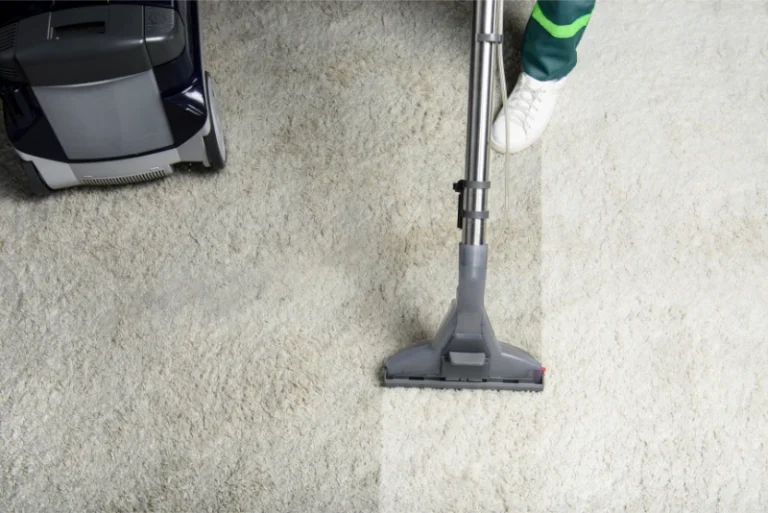
Hot water extraction at 230°F provides the thermal energy that breaks the weakened bond and mobilizes the particle into the water stream. The immediate extraction phase removes the mobilized particle from the fiber before it can re-bond. A rental machine operating at 140 to 160°F does not reach the temperature threshold. Truck-mounted systems carry the water temperature in a short insulated line. By the time the water hits the fiber, it is still close to operating temperature. The physics work. The particle comes out.
The Rogue Valley Fire Season Carpet Checklist
During an AQI event above 150: Close all windows and set HVAC to recirculate rather than draw outside air. Replace HVAC filters within one week of the event ending. If you can smell smoke inside your home with windows closed, assume PM2.5 has penetrated.
Within 30 days of air clearing: Schedule professional carpet cleaning. This is the window where results are most complete from a single session. Combine with upholstery cleaning if sofas and chairs were in smoke-affected rooms.
30 to 60 days: Still cleanable with good results, may require slightly more aggressive pre-treatment. Schedule before winter wood stove season begins to avoid compounding problems.
Beyond 90 days: Results will be less complete. A second session may be needed. Wood stove soot from October onward compounds the existing smoke contamination.
Frequently Asked Questions
Can air purifiers alone handle wildfire smoke in a Medford home?
Air purifiers with HEPA filters capture airborne PM2.5 particles effectively while the smoke is still in the air. Once the particles have settled and bonded to carpet fibers, an air purifier cannot help. It is filtering air, not fiber. Running a HEPA purifier during a smoke event reduces the volume of particles that settle into carpet. That is valuable. But it does not eliminate the problem — some settling always occurs regardless of purifier effectiveness during a sustained event.
Is there a health risk from PM2.5 in carpet fibers?
Bonded PM2.5 in carpet fibers can re-enter the air through foot traffic, children playing on the floor, and HVAC airflow across the carpet surface. For households with asthma or respiratory conditions — a significant concern in Medford given the valley’s seasonal allergen burden — removing settled particles from carpet is a meaningful air quality action, not just cosmetic cleaning.
Does the Almeda Fire area (Phoenix and Talent) have different smoke-related carpet issues?
The Almeda Fire destroyed approximately 2,500 structures in Phoenix and Talent in September 2020. Homes rebuilt since 2020 are newer construction with better air sealing, which reduces PM2.5 infiltration. However, both communities sit within the same Rogue Valley bowl as Medford and experience the same geographic smoke concentration. Wildfire smoke remains a recurring seasonal challenge regardless of construction year.
How much does post-wildfire carpet cleaning cost in Medford?
Wildfire smoke carpet cleaning in Medford runs $130 to $200 for a standard 3-bedroom home, slightly above our standard rate because of the alkaline pre-treatment step and longer extraction process. Price is stated before work starts and does not change. Call (458) 346-2026 for a quote based on your home’s square footage and smoke exposure history.
Medford Carpet Cleaner is based at 34 S Fir St, Medford, OR 97501. We serve all of Jackson County including Medford (97501 and 97504), Central Point, Eagle Point, Ashland, Jacksonville, White City, Phoenix, Talent, and Grants Pass. Same-day wildfire smoke cleaning is available during fire season when you call before noon. Call (458) 346-2026.
Smell Wildfire Smoke in Your Medford Home?
The only carpet cleaning operation in Jackson County specializing in PM2.5 smoke removal using alkaline pre-treatment and commercial-temperature hot water extraction. Same-day available during fire season.
34 S Fir St, Medford, OR 97501 • Mon–Sat 7am–7pm