
Bear Creek & Table Rocks Trail Mud: What It Does to Your Carpet and How to Get It Out
If you hike around Bear Creek Greenway, Table Rocks, or the Rogue River trails near Medford between November and April, you know the mud. The Rogue Valley’s signature red-brown clay soil — iron-rich and sticky when wet — follows you home on boots, dog paws, and kids’ shoes and works its way into carpet fiber fast. It’s one of the most common carpet problems we see in Jackson County homes from late fall through spring.
This guide covers what makes Rogue Valley trail mud particularly stubborn, what you should and shouldn’t do immediately after it gets tracked in, and what professional cleaning can and can’t fix.
The counterintuitive rule: Do not try to clean fresh mud from carpet. Let it dry completely first. Attempting to remove wet clay spreads it horizontally through the fiber and pushes it deeper into the pile. Dry clay vacuums out far more effectively than wet clay scrubs out.
What Makes Rogue Valley Mud Different
Not all mud is equal when it comes to carpet. The soil around Bear Creek, Table Rocks, and the Rogue River corridor is predominantly iron-rich red clay — the same geology that gives the valley its distinctive reddish-brown soil color.
Iron clay has specific properties that make it harder to remove from carpet than general dirt:
- High surface area: Clay particles are extremely fine, with very high surface area relative to their mass. This means more contact with carpet fiber and stronger adhesion.
- Charge bonding: Clay particles carry a negative electrical charge that causes them to bond to carpet fiber (which is slightly positive) more strongly than neutral soil particles.
- Staining compounds: The iron oxide in red clay leaves a rust-tinted stain in light-colored carpet fiber even after the clay itself has been removed. This is the brownish shadow that remains after DIY cleaning.
- Depth penetration: Fine clay particles pushed into carpet while wet can penetrate all the way to the backing — much deeper than coarser soil types.
The Right Order of Operations After Trail Mud
Step 1: Don’t touch it yet — let it dry
This is the hardest part for most people. A large muddy footprint on clean carpet feels urgent. But wet clay is at its most mobile state — any pressure, friction, or moisture application will spread it further and push it deeper. The best thing you can do is close off the room, let air circulate, and wait for the mud to fully dry. Depending on how much was tracked in, this takes 2–6 hours.
Step 2: Vacuum thoroughly — multiple passes
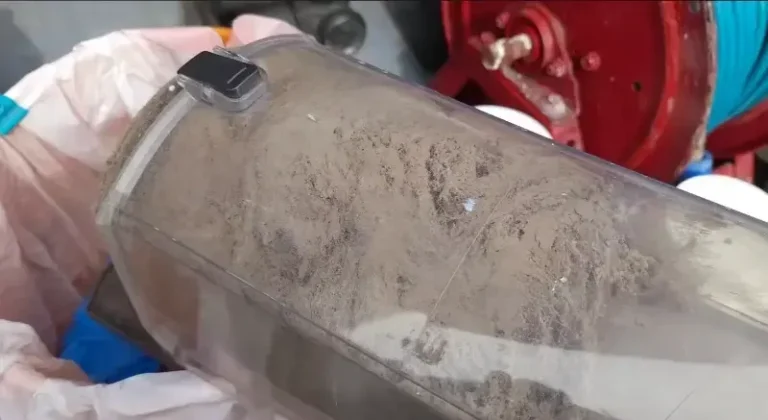
Once fully dry, clay mud becomes brittle and breaks into powder that vacuum suction can capture. Use your vacuum on the highest suction setting and make multiple slow passes in different directions over the affected area. The goal is to remove as much dry clay as possible before any moisture touches the carpet.
A stiff-bristle brush (the kind used for upholstery) can help break up dried clay chunks before vacuuming. Work from the outside of the stain toward the center to avoid spreading.
Step 3: Assess what remains
After thorough vacuuming, examine what’s left. For light clay tracking on relatively new carpet, vacuuming alone may remove 80–90% of the material. What remains is usually a faint rust-colored shadow from the iron oxide. For heavy tracking on older carpet with worn fiber, significantly more will remain embedded in the backing.
Step 4: Targeted pre-treatment (if DIY cleaning)
If you want to attempt DIY cleaning of the remainder, use a cool water and mild dish soap solution — not hot water (heat can set iron staining), not vinegar (acid can react with iron compounds), not club soda. Apply sparingly with a clean white cloth, blot from outside inward, never scrub. Rinse with cool water and blot dry.
This works for minor residual shadow on low-pile carpet. It won’t fully remove deep-embedded clay from dense pile carpet or old iron oxide staining.
What to avoid: Hot water sets iron oxide staining. Scrubbing spreads clay and damages fiber. Vinegar or acid cleaners react badly with iron compounds. Steam cleaning on wet clay pushes it deeper before the steam can extract it.
What Professional Cleaning Adds
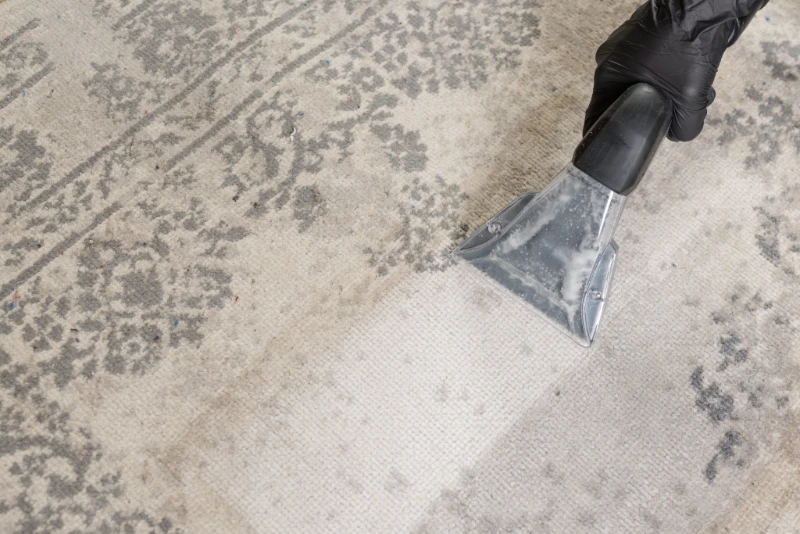
Professional hot water extraction with targeted clay pre-treatment removes what DIY cleaning leaves behind. Here’s what’s different about the professional process:
Clay Release Pre-Spray
A targeted pre-spray formulated for iron clay soil is applied 5–8 minutes before extraction. It breaks the charge bond between clay particles and carpet fiber so extraction pulls the clay out rather than just moving it around.
Extraction Temperature
Truck-mounted hot water extraction at proper temperatures loosens clay bonds that cool-water DIY methods can’t break. The combination of chemistry and temperature is what achieves full removal on dense pile.
Iron Stain Treatment
For rust-orange iron oxide staining that persists after clay removal, we apply a dedicated rust remover formulated for carpet fiber — a different chemistry than the clay pre-spray. This requires testing on a hidden area first.
Agitation
A soft rotary agitation head (not a scrubbing brush) works the pre-spray into the fiber before extraction. This physical agitation combined with the clay release chemistry removes embedded particles that extraction alone misses.
Realistic Expectations for Old Trail Mud Stains
The fresher the mud stain, the better the result. Clay mud that was tracked in last week and vacuumed properly before calling us will typically come out 95–100% — visible staining eliminated, no shadow remaining.
Clay mud that was tracked in, scrubbed while wet, and has been in the carpet for months or years is a different situation. The scrubbing-while-wet spread the clay horizontally and pushed it into the backing. Iron oxide staining has had time to chemically bond to the fiber. Professional cleaning will significantly improve the appearance, but complete elimination of old iron oxide staining isn’t always possible without fiber damage.
We assess the realistic outcome honestly on the walk-through before we charge you for cleaning. If we think a stain is beyond what extraction can fully fix, we’ll tell you before we start.
High-Risk Seasons and Trails in Jackson County
The worst mud tracking periods in Jackson County are:
- Late November through February: Peak clay mud season as winter rains saturate the topsoil along Bear Creek, the Rogue River, and around Table Rocks.
- March and April: Snowmelt from the Cascades increases soil saturation in the Upper Rogue corridor and along Eagle Point trails.
- After any significant rainfall, year-round: Even in summer, a heavy July thunderstorm can turn Table Rocks access roads into red clay slurry within hours.
The highest-risk trails for clay tracking include Table Rocks (Lower and Upper), Bear Creek Greenway between Medford and Ashland, the Rogue River National Recreation Trail near Eagle Point, and the Applegate River trails southwest of Jacksonville.
Trail Mud in Your Carpet?
Call us for a same-day quote. We’ll tell you over the phone whether the stain you’re describing sounds like a standard clay cleaning or a more involved iron oxide situation — before you book anything.
Call (458) 346-2026Prevention: The Boot Room Habit
The most effective solution to trail mud in carpet is a dedicated entry transition — even a simple boot tray and mat system at the main entry point eliminates 90% of carpet mud incidents. The key components:
- A hard surface entry zone (tile, vinyl, or concrete) immediately inside the door where boots come off
- A boot tray deep enough to contain actual mud clumps (not a thin flat mat)
- A coarse-bristle mat outside the door for initial scraping
- A hook or shelf so wet boots air-dry upright rather than sitting in their own mud
For dog owners, a designated paw-wiping zone near the entry door — a towel station or a shallow wash basin for paws — dramatically reduces the clay transferred from dog paws to carpet after trail walks.